You Can’t Fix What You Can’t See
Written By
Most marketing teams have a general sense of how their website is performing. What they often do not have is a clear picture of what it is actually doing, where leads are falling out, and what a thorough audit would surface. That gap is more expensive than it looks.
Ask a marketing team how their website is performing and you will usually get an answer built around the metrics they track: traffic, bounce rate, maybe conversion rate on a key page or two. That information is useful. It tells you something is working or not working. It rarely tells you why, and it almost never tells you what specifically to fix.
The gap between knowing a number is off and knowing what to do about it is where most website improvement efforts stall. Teams run the same pages through the same tools, get the same general picture, and make the same general improvements. The site gets incrementally better. The underlying issues, the ones that require a more thorough read, stay in place.
Getting a real picture of what a website is doing has traditionally required either significant internal time or paying someone to do it. Run it through a performance tool. Check the SSL status. Look for broken links. Audit the copy for messaging gaps. Try submitting the contact form. Each check happens in a different tool, returns a different kind of output, and requires synthesis before it means anything actionable.
Most teams do not have the time for that level of audit on their own properties, let alone regularly. So, it does not happen. The site underperforms in ways that are mappable but unmapped, and the problems compound quietly over time.

What a Thorough Audit Actually Surfaces
The surface-level read of a website tells you what the site says it does. A thorough audit tells you what it actually does.
At the obvious level, you can assess performance, page speed, and basic technical health. Most teams have some visibility here through standard tools. What they rarely have is a complete picture of the second and third layers, where the more significant findings tend to live.
The Performance Layer
This is where most improvement efforts focus, and where the most visible gaps appear. Lead capture forms that are broken or misconfigured cost the business inquiries it does not know it is losing. Calls to action that are present but ineffective point visitors toward friction rather than conversion. Messaging across pages that tells inconsistent stories suggests a company that is mid-transition or operating without a unified point of view.
The Risk Layer
A thorough audit also surfaces findings that go beyond performance: the issues that create legal, reputational, or technical exposure. Old landing pages still live and driving traffic that no one on the current team knows about. Publicly accessible content that was never meant to be indexed. ADA compliance gaps that create legal risk. Outdated technology and security vulnerabilities that undermine visitor trust before a single word of copy registers. Performance gaps in technical SEO and AEO that are quietly costing credibility and discoverability with every passing month.
These are not optimization opportunities. They are active liabilities, and most teams discover them only after something goes wrong.
The Interpretive Layer
What does this site, looked at as a whole, tell you about where the business is right now? What are the biggest risks to performance and conversion? Where are the highest-leverage opportunities? That kind of synthesis is what turns a list of findings into something a marketing team can actually prioritize and act on. Most teams have never had it.
Where AI Changes the Audit Equation
The traditional audit process is time-consuming because it requires both breadth and interpretation. You need to check a lot of things, and then you need to make sense of what you found in a way that is useful to a non-technical team. Those two steps together are what makes a meaningful audit expensive and rare.
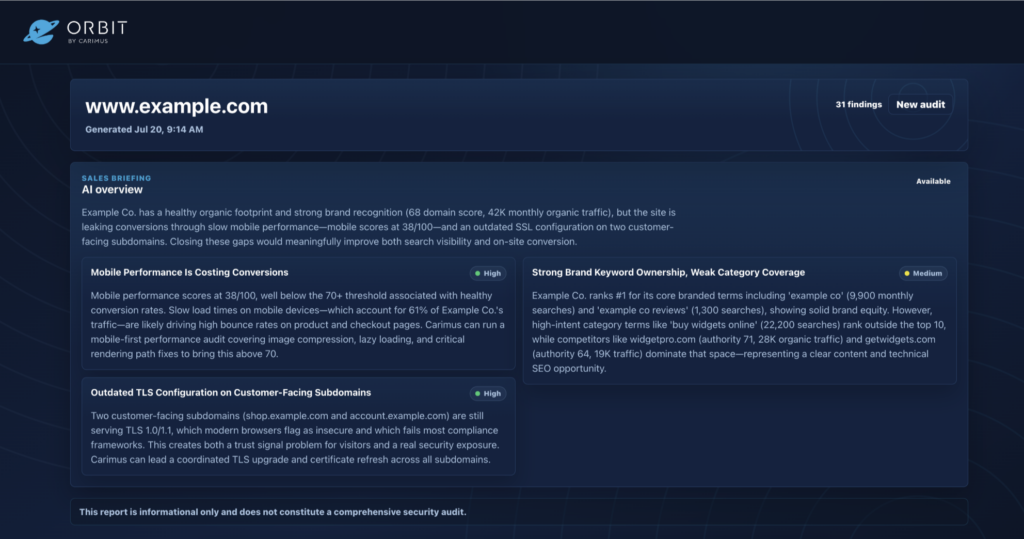
Orbit addresses the first part. It pulls findings across performance, SEO, security, and conversion signals into a single view, scanning the publicly available signals your paid and organic traffic run into every day. That aggregation step alone removes significant manual effort from the process.
The interpretation is where a Carimus strategist comes in. A raw list of findings is not a prioritized action plan. A Carimus strategist reviews the results with your marketing goals in mind: what the findings actually mean for your business, which issues are worth addressing first, and what a reasonable path forward looks like. The output is not a data dump. It is a findings summary that a marketing director can read and act on without needing a developer to translate it first.
A broken lead capture form is a fact a tool can confirm. Recognizing that it is the primary conversion point on the site, and that the business is likely losing qualified inquiries every day without knowing it, is the kind of insight that requires a human layer on top of the data.
The Free Orbit Audit
If you want a clearer picture of what your site is doing before committing to a larger engagement, that is exactly what the free Orbit audit is for.
The process is straightforward. Submit your domain through the Carimus site. We run it through Orbit and return a summary of the most significant findings, prioritized by business impact rather than technical severity. What comes back is written to be understood by a marketing team, not a development team.
One thing worth being clear about: this is an informational audit based on publicly available information. It is not a replacement for a comprehensive paid engagement, and we say that explicitly. The value is in what it surfaces and where it points the conversation. Organizations that have seen their own site through Orbit tend to come away with a clearer sense of where to focus and a better foundation for whatever comes next.
There is no cost and no pitch attached to receiving it. If the findings lead somewhere, that conversation starts from a more informed place than most first calls ever do.
Submit your domain for a free Orbit audit. Find out what your site is actually doing.Request your free audit here >.
Ready to reveal what’s slowing down your site performance? Get in touch today.
“What I love about the culture at Carimus is that it thrives on a foundation of passion and excellence, where every individual is not just an employee but a valued contributor to our shared success story.
”
Blog & Posts