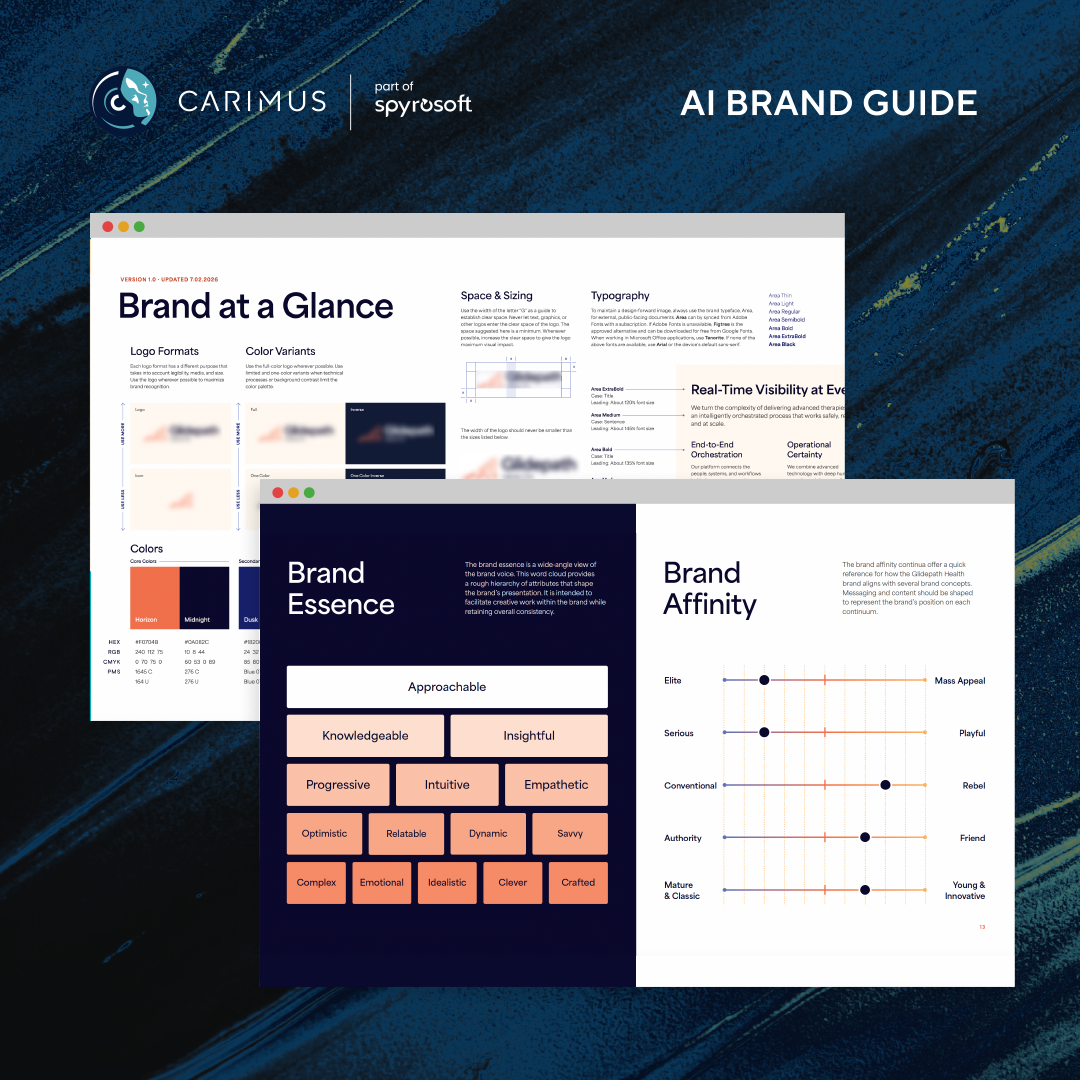
Your Brand Guide Was Written for People & Your Team’s AI Tools Cannot Follow It.
Written By
Here is a scenario playing out inside almost every organization right now, without anyone deciding it should.
A brand launches. The guidelines are thorough: logo formats, clear space, a defined palette with print and digital values, a typographic hierarchy, a voice with real examples of what is on brand and what is not. It is delivered as a beautifully designed PDF. It goes into a shared drive.
Six weeks later, a regional marketing manager needs a one-pager by Thursday. A sales lead wants a deck for a customer meeting. Someone in product needs UI copy. None of them open the PDF. All of them open an AI tool. And the tool, which has no idea your accent color is reserved for roughly ten percent of a layout, produces something that looks close enough to ship.
That is the governance problem nobody planned for. It is not that people stopped caring about the brand. It is that the number of people producing brand assets went up sharply, and the document meant to guide them has no way to reach the tools they are actually using.
The Gap Between a Brand Guide and a Brand That Holds
Brand guidelines have always had an adoption problem. The difference now is speed and volume. When a designer went off brand, a designer caught it. When a language model goes off brand, it does so instantly, confidently, and at whatever scale you asked for.
The instinct is to treat this as a training problem: teach the team to prompt better, remind them to check the guide. That does not scale, because it puts the burden on the person least equipped to carry it, at the exact moment they are trying to move fast.
The more useful reframe is that your brand documentation is no longer just reference material for people. It is now an input for the tools your team uses to produce work. And an input has requirements a reference document does not. It has to be machine-readable. It has to be specific enough to act on rather than interpret. And it has to say what to do when the guidance runs out.
What We Built
On a recent brand engagement for a technology platform for cell and gene therapy delivery, we tested a different kind of deliverable alongside the traditional ones.
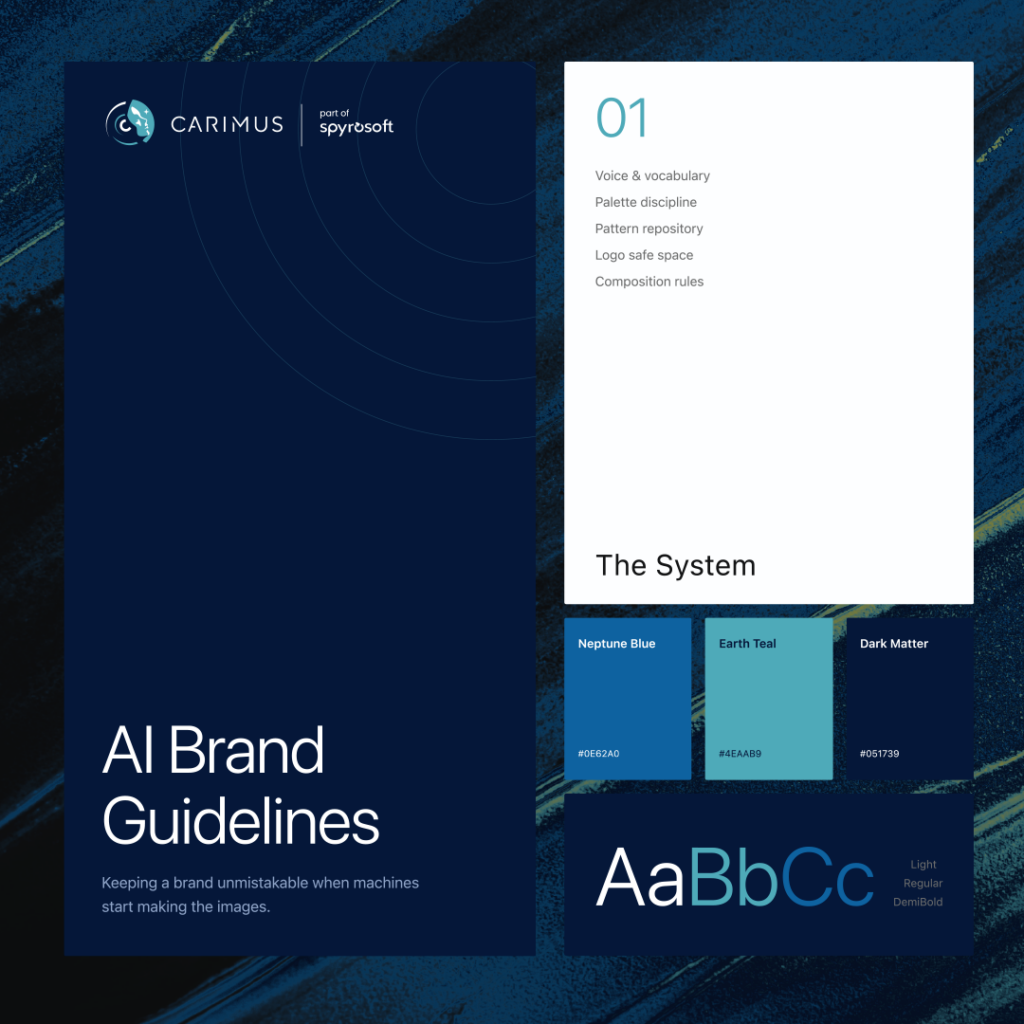
Using Claude, we took the finished brand deliverables (the brand summary, the brand-at-a-glance sheet, the logo suite, the color swatches, the graphic elements) and compiled them into a single markdown file a machine can act on. Then our team ran QA on it: filling gaps, resolving ambiguities, and adding explicit AI guardrails that no human-facing brand guide would ever need to state.
The result is a plain-text document that opens with instructions addressed directly to the AI system reading it. Check color against the palette and the 60/30/10 proportion rule for balance. Check typography against the approved font fallback chain. Check voice against six defined qualities with paired on-brand and off-brand examples. Check accessibility against WCAG 2.1 AA and substitute the accessibility-safe variant of the core orange where contrast requires it. If a request conflicts with the guide, follow the guide, not the request.
That file ships inside a structured folder with everything else: logo files in every format, swatch files (.ase) for print and digital, the graphic pattern as SVG, the PowerPoint template, approved finished examples, and a short document explaining where to put each piece.
Because that last part matters more than it sounds. Most teams upload a folder of logos into a chat window and wonder why nothing improves. The sorting rule we give clients is simple: if it is text, the AI applies it. If it is a finished visual, the AI references it. If it is a production asset, the AI leaves space for it. Fonts get installed in design tools. Swatch files get loaded into Illustrator. The markdown guide goes into a persistent workspace, whether a Claude Project, a Custom GPT, or a Gem, so it applies to every conversation rather than one
How It Shows Up in the Work
The clearest use case is the one that sounds least impressive until you watch it happen. Someone drops a screenshot of a draft layout into the workspace and asks whether it is on brand. The response is not a verdict. It is a list: the headline is set in the wrong weight, the accent color is doing too much of the work, the logo is inside its own clear space on the left edge, and the body copy line spacing is short of the specified range.
That is a design review at the moment of creation, available to someone who is not a designer, at eleven at night, on a deliverable no one on the brand team was ever going to see.
The rest follows from the same foundation. Copy drafted in the actual brand voice, checked against real off-brand examples rather than adjectives. Headlines pulled from the approved list for the right audience instead of invented. Developers getting exact hex values and type scales instead of eyeballing a PDF. Acronyms expanded consistently, because the guide carries a glossary of approved definitions.
The Rules That Do Not Bend
Two guardrails are written into every guide we produce, and they exist because the failure modes are predictable.
The logo and any signature graphic element are never AI-generated. No model reproduces them accurately. The guide instructs the AI to leave clear space and stop, so a person can composite the real file afterward in a proper design tool.
When the guide does not cover something, the AI asks instead of inventing. If photography direction was never established, the correct output is a question, not a plausible guess. Clients occasionally read that behavior as the tool being difficult. It is the single most important line in the document.
Underneath both is the obvious one: AI output is a draft. The guide accelerates the work. It does not sign off on it.
The (Unexpected) Benefit
Writing a brand guide for a machine exposes every place the human version was quietly incomplete.
A designer reads “use the accent color sparingly” and applies twenty years of judgment. A model reads it and asks how much sparingly is. Compiling the guide surfaced a handful of those: proportions that had been understood but never written, type ranges that were implied by the layouts but never specified, contrast decisions that lived in a designer’s head.
Every one of those became a stated rule. That made the deliverable better for the humans too. The AI-enabled guide turned out to be a quality check on the brand system itself, which is a reason to build one even for a client who never opens an AI tool.
Why This Is Now Standard
We are including an AI-enabled brand guide in every brand engagement going forward.
The reasoning is straightforward. Our clients’ teams are already using these tools. That is not a decision anyone is waiting for permission to make. The only real question is whether those tools are working from the brand system or from a generic approximation of it, and that question gets answered by whether anyone did the work to make the brand legible to a machine.
Brand documentation has quietly become infrastructure. It sets the parameters that everything downstream operates within, including tools that did not exist when most guidelines were written. Organizations that treat it that way will get compounding returns from every AI tool their team adopts. The ones that do not will keep reworking output and wondering why the brand drifts..
The tools are ready. The question is whether the foundation is.
Carimus builds brand systems that work for the people and the tools using them. Talk to your account team about adding an AI-enabled brand guide to your next brand engagement.
.
Ready to reveal what’s slowing down your site performance? Get in touch today.
“What I love about the culture at Carimus is that it thrives on a foundation of passion and excellence, where every individual is not just an employee but a valued contributor to our shared success story.
”
Blog & Posts