What If the Bottleneck Was Never the Writing?
Written By
Most teams optimized for faster drafts. The real production constraint is everything that happens after one exists.
There is a version of AI for marketing that nobody wants: more noise. More generic content flooding every channel. More posts that sound like they came from the same machine, because they did. More volume with no corresponding increase in quality, structure, or results.
That is not the opportunity. That is the trap.
The real opportunity is narrower and more useful. It is identifying the specific gaps in your marketing workflow where AI creates genuine leverage, and filling those gaps without creating new problems in the process. Most organizations are doing the opposite: adding AI tools on top of existing workflows without changing the workflows. Generating more content without improving what gets produced. Spending more time managing AI output than they saved by using it.
The teams getting real value from AI are doing something different. They are not using it to do more of the same thing. They are using it to restructure where their team’s time and judgment go.

The Real Cost of How Web Content Gets Made
What percentage of your total production time goes to getting a finished page in front of someone who can improve it?
For most teams, that number is higher than anyone has measured, because it has two parts that rarely get tracked together. The first is writing time. Getting from a brief to a draft takes hours, particularly for longer or more structured pieces. The second is build-out time, and this is the one that disappears from the accounting entirely.
Once copy exists, someone has to build it into the site. That means selecting the right blocks, structuring the layout to support the narrative, making decisions about hierarchy and flow that determine whether the page converts or just sits there looking reasonable. On teams without a dedicated web producer, that work falls to whoever is available. On teams that do have one, it creates a queue. Either way, it takes time that does not show up in a content calendar but shows up in every delayed launch and every page that shipped half-finished.
The later stages, where the real performance leverage lives, get compressed as a result. Optimization, A/B testing, updating underperforming pages, improving CTAs based on what the data actually shows: these activities get deprioritized not because they are low value but because there is no time left after writing and build-out.
This pattern repeats across an entire content library. Pages that were good enough at launch but never got better. Blog posts that ranked on page two and never got the hour of attention that might have moved them to page one. Landing pages with conversion rates that nobody went back to improve. The compounding cost is significant, and it is almost entirely a function of where production time goes. The goal is not more content. It is content that gets better over time, because the team has capacity to give it the attention it deserves.
The real opportunity is narrower and more useful. It is identifying the specific gaps in your marketing workflow where AI creates genuine leverage, and filling those gaps without creating new problems in the process. Most organizations are doing the opposite: adding AI tools on top of existing workflows without changing the workflows. Generating more content without improving what gets produced. Spending more time managing AI output than they saved by using it.
The teams getting real value from AI are doing something different. They are not using it to do more of the same thing. They are using it to restructure where their team’s time and judgment go.
The Build-Out Gap: When the Draft is Done but the Page is Not
One of the most consistent gaps in marketing operations is the distance between a finished draft and a finished (web) page.
Language models are genuinely good at producing first drafts. Writing is a problem AI has largely solved: the time from brief to something worth reacting to has compressed significantly for teams using AI-assisted workflows. But a draft is not a page. Once the writing is done, someone still has to structure it for the web: selecting the right content blocks, arranging the layout to support the narrative, mapping headings to the design hierarchy, and making sure the final output matches what your design system expects. That step does not show up in a content calendar, but it shows up in every delayed launch.
This is where most AI content tools fall short in a way that is easy to overlook. They produce copy. What they do not produce is a structured content object that fits your web environment and brand. Someone has to rebuild it before anyone can work with it, which means the time saved on the writing side largely disappears on the build-out side.
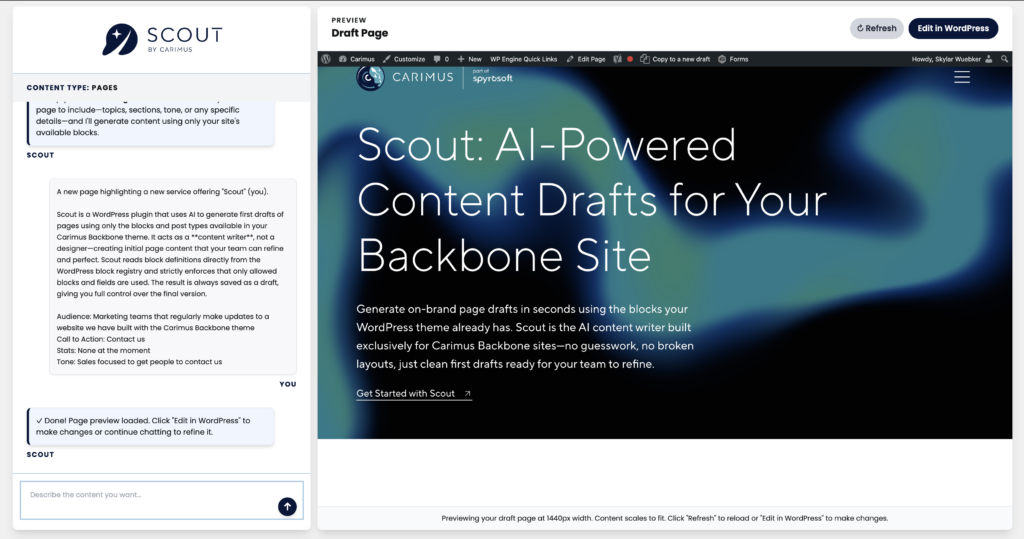
Carimus’s new AI agent, Scout, addresses both steps. It is delivered as a WordPress plugin for structured AI content generation, generating page content layouts using the blocks and structures already in your site. The output is not a freeform draft that needs reformatting, but rather a structured draft: the AI selects appropriate content blocks, arranges the layout, and produces something an editor and a web producer can work with immediately. The result is a page that fits your design system from the start, not a paste job that has to be rebuilt before it is usable.
The goal is not more content for its own sake. It is content that gets built faster and gets more attention after launch, because the team has capacity left for the optimization and iteration that determine whether a page actually performs.
What Structured Generation Actually Means
There is a meaningful difference between a generic AI writing tool and structured content generation.
Most AI tools produce copy for any context, in any format, and leave you to figure out whether it fits your site, your blocks, and your design system. The output is words. What you need is a page. The gap between those two things is where the time goes.
Structured generation starts from a different premise. The tool knows what your site looks like. It knows which content blocks are available, how your pages are built, and what your design system expects. The draft it produces is not generic output waiting to be shaped and rebuilt. It is a starting point that already fits your environment: structured, block-ready, and usable by an editor and a web producer without reformatting it from scratch.
That distinction matters because it is the difference between AI that creates work and AI that removes it. When a first draft already conforms to your site’s structure and reflects your brand context, the work that follows is genuinely faster and more focused. Your team is making decisions about quality and substance, not rebuilding a layout that should never have needed rebuilding.
The Brand Foundation Question
The quality of what AI produces is directly tied to the quality of what you give it to work from.
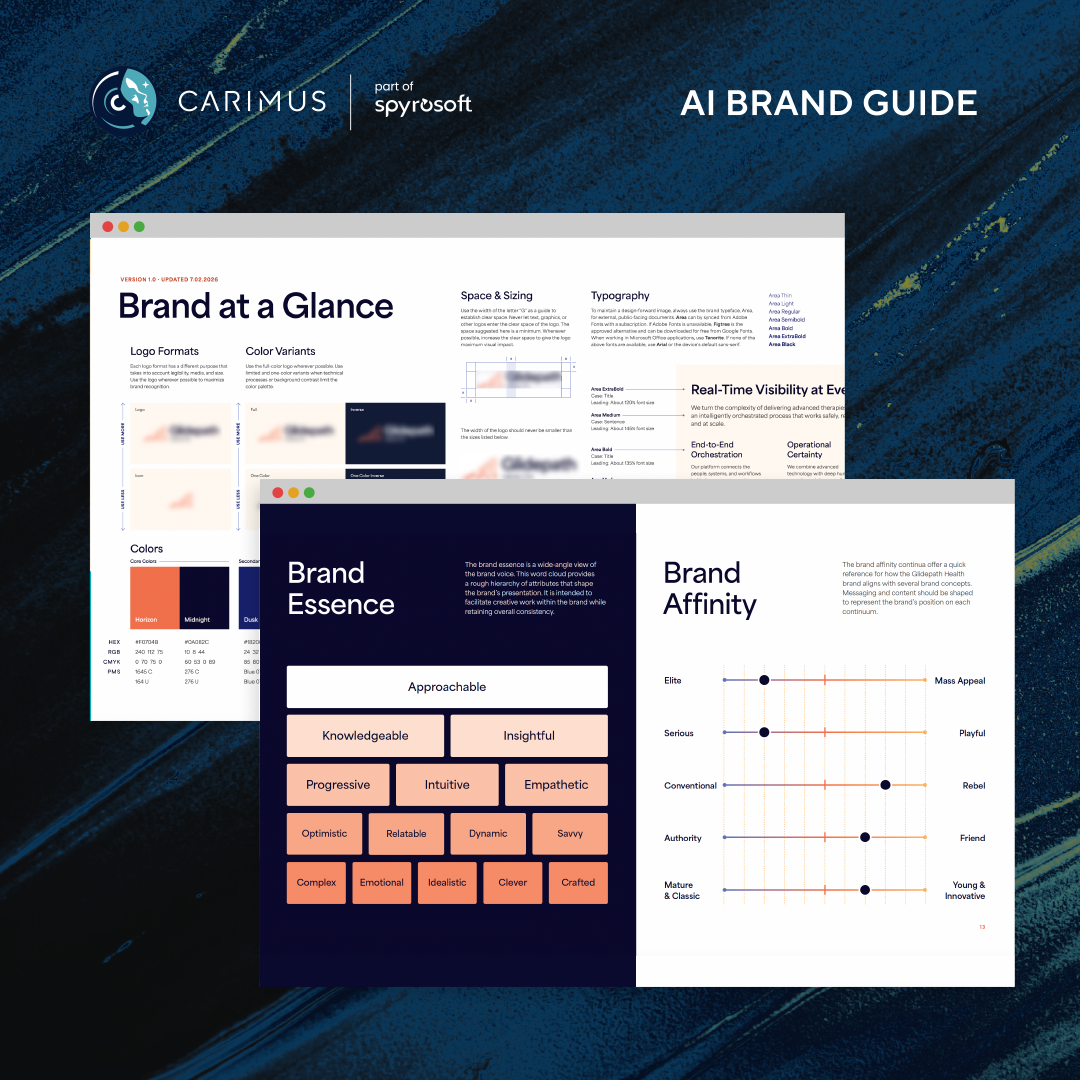
Brand voice. Tone guidelines. Content examples. The specific language your audience responds to and the specific language your brand avoids. These inputs determine whether AI-assisted content sounds like your organization or like a generic approximation of it. They also determine whether the structured output it produces reflects your actual design intent or just a plausible guess at what a page should look like.
This is why brand foundation work has become more important in an environment where teams are using AI to assist with content production, not less. You are not just creating guidelines for human writers anymore. You are setting the parameters your digital tools work within. The clearer and more specific those parameters are, the more useful the output becomes.
Organizations that invest in this foundation now will get compounding returns from every AI content tool they adopt. Those that skip it will keep doing extensive rework on every piece of AI-assisted output and wonder why the tools are not living up to their promise.
How Scout Works
Scout is a WordPress plugin that generates first-draft page content using the blocks and structures already in your site. A content producer describes what they need. Scout asks clarifying questions when the brief is ambiguous. The result is a structured draft, built in your blocks, ready for editorial and web review. It is never published directly. Human review is a requirement, not an option.
For teams managing high volumes of page content, Scout compresses the time from brief to something worth editing from hours to minutes. That time comes back to the people who know what good looks like. They spend it on revision, optimization, and the iteration that determines whether content actually performs.
Because Scout works within your site’s block system, every draft it produces is already aligned with your architecture. That reduces the variability that accumulates when multiple contributors are building pages independently and makes the overall content library more coherent over time, without requiring a separate governance layer to enforce it.
Want to see what structured content generation looks like on your actual site? Talk to Carimus account team about Scout.
Ready to move faster? Get Scout for your website. Get in touch today.
“What I love about the culture at Carimus is that it thrives on a foundation of passion and excellence, where every individual is not just an employee but a valued contributor to our shared success story.
”
Blog & Posts