Enterprise Web Consolidation
Written By
Enterprise Web Consolidation: What it Is and Why it Matters Now
Most large organizations don’t have a single website. They have dozens, sometimes hundreds, spread across different platforms, teams, and business units. Over time, those sites accumulate through acquisitions, regional needs, product launches, and quick-turn initiatives that solve immediate problems.
For a while, this kind of growth feels manageable. Each new site has a purpose, each platform has a rationale, and each team is able to move at its own pace. But eventually, the cracks start to show. What once felt like flexibility begins to feel like fragmentation. Quickly, software becomes outdated (creating security risk), Compliance is difficult to ensure across properties, and maintaining the skills to manage multiple platforms becomes unwieldly.
The conversation shifts. It is no longer about maintaining individual sites, but about understanding how any of it is supposed to function as a whole. That shift is where enterprise web consolidation begins.

What Enterprise Web Consolidation Actually Means
Enterprise web consolidation is often reduced to a technical exercise. In reality, it is much broader than that.
At its core, it is a strategic effort to bring structure to a digital ecosystem that has grown organically over time. It requires rethinking not just platforms, but how content, teams, and experiences operate as a connected system.
In practice, that means addressing several interconnected areas:
- Platform rationalization: deciding which systems to keep, consolidate, or retire
- Information architecture: defining how sites, domains, and experiences relate to one another
- Shared content models & design systems: creating reusable templates and structures that support consistency
- Governance & ownership: clarifying who makes decisions and how
- Operational workflows: aligning how content is created, reviewed, and published
- Risk management & regulatory compliance: Assessing, monitoring, and mitigating risks associated with software platforms and compliance with regulatory frameworks.
Taken together, these are not cleanup tasks. They are design decisions.
How Fragmentation Happens
Fragmentation rarely comes from poor decision-making. In most cases, it is the result of many reasonable choices made in isolation.
A product team launches a microsite to meet a deadline. A regional office adopts a platform that better supports local needs. An acquisition introduces an entirely new technology stack. A business unit selects tools that allow them to move faster without waiting on central approval.
Each of these decisions solves a real problem. Taken together, they create an environment that was never intentionally designed. It evolves incrementally, without a shared structure or long-term plan.
Over time, that lack of structure becomes harder to ignore.
Recognizing the Signs
Most organizations feel the impact of fragmentation before they formally name it.
The symptoms tend to show up in patterns:
- Multiple CMS platforms doing essentially the same job
- Websites that feel disconnected, with no shared structure or logic
- Inconsistent design, tone, and user experience
- Duplicate or conflicting content across properties
- Unclear ownership and slow or complex decision-making
Individually, these issues are manageable. Collectively, they create friction that slows everything down.
Why it Becomes a Business Issue
At a certain point, fragmentation stops being a web problem and becomes a business constraint.
Costs begin to rise in ways that are not always immediately visible. Teams spend more time maintaining systems than improving them. Launch timelines stretch. Implementing changes requires navigating multiple platforms and approval structures.
At the same time, risk increases:
- Security and compliance gaps become harder to monitor
- Accessibility issues are more difficult to address consistently
- Brand consistency weakens across regions and business units
- Knowledge becomes siloed within teams and tools
McKinsey research has similarly pointed to the growing operational burden created by fragmented and difficult-to-integrate technology environments, particularly in large enterprises.1
What begins as manageable growth turns into structural drag.
What Consolidation Looks Like in Practice
When organizations approach consolidation strategically, the goal is not to force uniformity, but to introduce coherence.
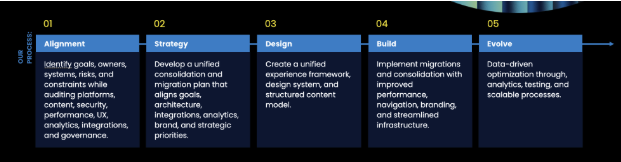
At Carimus, consolidation efforts typically follow five connected phases: alignment, strategy, design, build, and ongoing evolution.
It begins with discovery and alignment. Organizations assess the platforms, domains, integrations, content structures, governance models, and ownership patterns currently in place. The goal is to understand where fragmentation exists, where risk is concentrated, and which systems continue to support business needs.
From there, teams move into strategy. This includes defining consolidation priorities, identifying opportunities to simplify architecture, and creating a roadmap that aligns technology, content, brand, analytics, and operational goals.
Once the strategic direction is established, attention shifts to experience design and structure. Shared design systems, reusable content models, and consistent information architecture help create connected user experiences while still allowing flexibility across business units and regions.
The build and migration phase focuses on implementation. Organizations consolidate platforms, streamline infrastructure, improve navigation and performance, and reduce unnecessary operational complexity across the ecosystem.
But consolidation is not a one-time project. Long-term success depends on governance, analytics, testing, and operational processes that allow the ecosystem to evolve without returning to fragmentation over time.
Taken together, these stages create a more scalable and manageable digital environment, one where consistency, usability, and agility are supported by structure rather than constant manual oversight.
Why the Timing Feels Urgent
The need for consolidation is not new, but the conditions surrounding it have changed.
User expectations continue to rise, particularly around speed, consistency, and personalization. Regulatory requirements are becoming more complex, especially in industries with strict compliance standards. At the same time, organizations are investing in capabilities such as AI, advanced analytics, and connected digital experiences.
These capabilities depend on clean, well-structured systems. Without that foundation, they become difficult to implement and even harder to scale.
Consolidation is what makes those investments viable.
The Outcomes That Matter
When consolidation is approached strategically, the benefits extend across the organization.
Teams typically see:
- Fewer platforms to maintain and secure
- Faster time to market for campaigns and product launches
- More consistent and cohesive user experiences
- Clearer ownership and reduced internal friction
- Lower long-term operational cost and risk
Beyond efficiency, the deeper impact is control. Organizations gain the ability to operate their digital ecosystem intentionally rather than reactively.

From Managing Websites to Designing Systems
The most significant shift is not technical, but conceptual.
Organizations move from managing a collection of websites to designing and maintaining a digital system. That shift changes how decisions are made, how work is prioritized, and how success is measured.
Instead of reacting to immediate needs, teams begin to think in terms of long-term structure. Instead of solving problems in isolation, they consider how each decision affects the broader ecosystem.
This is what allows organizations to move from simply managing complexity to using it as an advantage.
Where to Start
For most organizations, the first step is not transformation. It is visibility.
That means understanding what actually exists:
- Sites and domains
- Platforms and integrations
- Content duplication and overlap
- Ownership and governance gaps
From there, teams can begin to identify where consolidation will have the greatest impact.
The most effective approaches are iterative. They focus on high-value opportunities first and build momentum over time, rather than attempting a single, large-scale overhaul.

Designing What Comes Next
Every large organization already has a digital ecosystem.
The difference is whether it has been intentionally designed or simply allowed to grow over time.
Left alone, that growth tends to follow the same pattern. New sites are added. New tools are introduced. Teams solve for immediate needs. Complexity accumulates quietly, until it begins to shape how the organization operates. Work slows down. Decisions become harder. Change becomes more expensive.
At that point, consolidation is no longer about simplification. It is about reclaiming control.
Done well, enterprise web consolidation creates more than efficiency. It establishes a system that can support growth, adapt to change, and make new capabilities possible rather than difficult. It gives organizations a foundation they can build on, rather than one they have to work around.
That shift, from reacting to complexity to designing for it, is what separates organizations that struggle to keep up from those that can move with intention.
What the End State Makes Possible
Security, Performance, and Scalability
A more unified ecosystem makes it easier to maintain security standards, improve governance, and support long-term scalability across digital properties.
- Automated updates across web platforms and experiences
- Standardized hosting infrastructure and governance policies
- Centralized access control and permissions
- Improved visibility across security and maintenance workflows
Preparing for Moments of Rapid Change
Mergers and acquisitions are often the moment when fragmented digital ecosystems are put under the greatest pressure. Increased traffic, rebranding demands, and accelerated integration timelines can quickly expose operational gaps, especially during post-M&A digital integration and large-scale website consolidation efforts. A more consolidated foundation makes it easier to:
- Align brands and digital properties
- Support traffic spikes and increased demand
- Launch new experiences more efficiently
- Create more consistent experiences across business units
Raising the Standard of Digital Experience
Shared systems and governance models help organizations create more consistent, scalable digital experiences without eliminating flexibility for individual teams or brands.
- Shared design systems and content standards
- Reusable experience templates
- Preconfigured analytics and integrations
- Governance models that support long-term consistency
At Carimus, this is the work we most often see behind the scenes. Not a single migration or redesign, but a broader effort to bring structure and alignment to ecosystems that have outgrown their original design.
Because every organization is already operating a digital ecosystem. The question is whether it is helping the organization move forward or quietly making change harder than it needs to be.
A clearer digital foundation starts with visibility.
Our enterprise web ecosystem assessment helps organizations identify fragmentation, governance gaps, and opportunities to reduce operational complexity over time.
Request an Assessment with Carimus to learn more >
Sources
- McKinsey & Company. McKinsey Technology Trends Outlook 2023. Published July 2023. Accessed May 6, 2026. https://www.mckinsey.com/capabilities/tech-and-ai/our-insights/the-top-trends-in-tech-2023#tech-trends-2023