AI Adoption Is the Easy Part. Knowing Where to Apply It Isn’t.
Written By
AI is not coming to Marketing, it’s here.
The organizations that figure out where it creates real leverage will have an advantage that compounds. The ones still debating whether to pay attention will not.
Let us be honest about where most organizations are right now. They are experimenting. Running pilots. Trying tools. Having internal debates about whether those tools are good enough, safe enough, or on-brand enough to use at scale. Generating reports about what other companies are doing with AI, which then get presented to leadership teams who are also generating reports about what other companies are doing with AI.
A smaller group has moved past the debate and started asking the more useful question: where exactly does AI create leverage in the work we are already doing, and what would it take to build that into how we operate? That question has concrete answers. Here is what we have found building and using AI tools inside our own practice.
The Problem with “More”
The default response to AI in a marketing context is to use it to produce more. More content. More posts. More emails. More ads. The tools make it easier to generate volume, so the instinct is to generate volume.
This is the wrong move for most organizations, and not because the output quality is too low. It is because more content in an already saturated environment does not create a proportional increase in attention or results. It creates noise. And more noise is the last thing most marketing teams should be adding to the channels they are trying to cut through.
The better question is not “how do we produce more?” but “where are the gaps we have not been able to fill, and what would filling them actually do for the business?” That reframe changes which AI applications are worth pursuing and which ones just add work without adding value.

The Build-Out Gap: When the Draft is Done but the Page is Not
One of the most consistent gaps in marketing operations is the distance between a finished draft and a finished (web) page.
Language models are genuinely good at producing first drafts. Writing is a problem AI has largely solved: the time from brief to something worth reacting to has compressed significantly for teams using AI-assisted workflows. But a draft is not a page. Once the writing is done, someone still has to structure it for the web: selecting the right content blocks, arranging the layout to support the narrative, mapping headings to the design hierarchy, and making sure the final output matches what your design system expects. That step does not show up in a content calendar, but it shows up in every delayed launch.
This is where most AI content tools fall short in a way that is easy to overlook. They produce copy. What they do not produce is a structured content object that fits your web environment and brand. Someone has to rebuild it before anyone can work with it, which means the time saved on the writing side largely disappears on the build-out side.
Carimus’s new AI agent, Scout, addresses both steps. It is delivered as a WordPress plugin for structured AI content generation, generating page content layouts using the blocks and structures already in your site. The output is not a freeform draft that needs reformatting, but rather a structured draft: the AI selects appropriate content blocks, arranges the layout, and produces something an editor and a web producer can work with immediately. The result is a page that fits your design system from the start, not a paste job that has to be rebuilt before it is usable.
The goal is not more content for its own sake. It is content that gets built faster and gets more attention after launch, because the team has capacity left for the optimization and iteration that determine whether a page actually performs.
The Visibility Gap: What Your Site is Actually Doing
The second gap is in visibility. Most marketing teams have a general sense of how their website is performing: traffic numbers, conversion rates, maybe some heatmap data. What they often do not have is a clear picture of what the site is actually doing at a structural level: where it is underperforming, what signals it is sending to visitors, where leads are falling out, and what a thorough audit would actually surface.
Getting that picture used to mean running your site through a handful of separate tools, manually synthesizing the output, and either handing a raw data dump to a developer or paying an agency to interpret it for you. Most teams do neither. The audit stays on the backlog, the problems stay unaddressed, and the site keeps underperforming in ways that nobody has fully mapped.
Carimus’s new AI agent, Orbit, changes that. It is an AI-powered website audit agent/tool that analyzes your digital properties and surfaces findings in plain language: what is working, what is not, where the biggest risks and opportunities are, and what is worth addressing first. The AI does not just return a list of technical flags. It interprets the findings, prioritizes by business impact, and translates the results into something a marketing team can actually act on.
The starting point is a free audit. Submit your domain through the Carimus site, and we will run it through Orbit and return a summary of the most significant findings. No technical background required to read it. No pitch attached to receiving it. Just a clear picture of what your site is doing, and where the gaps are.
The Foundation Everything Else Depends On
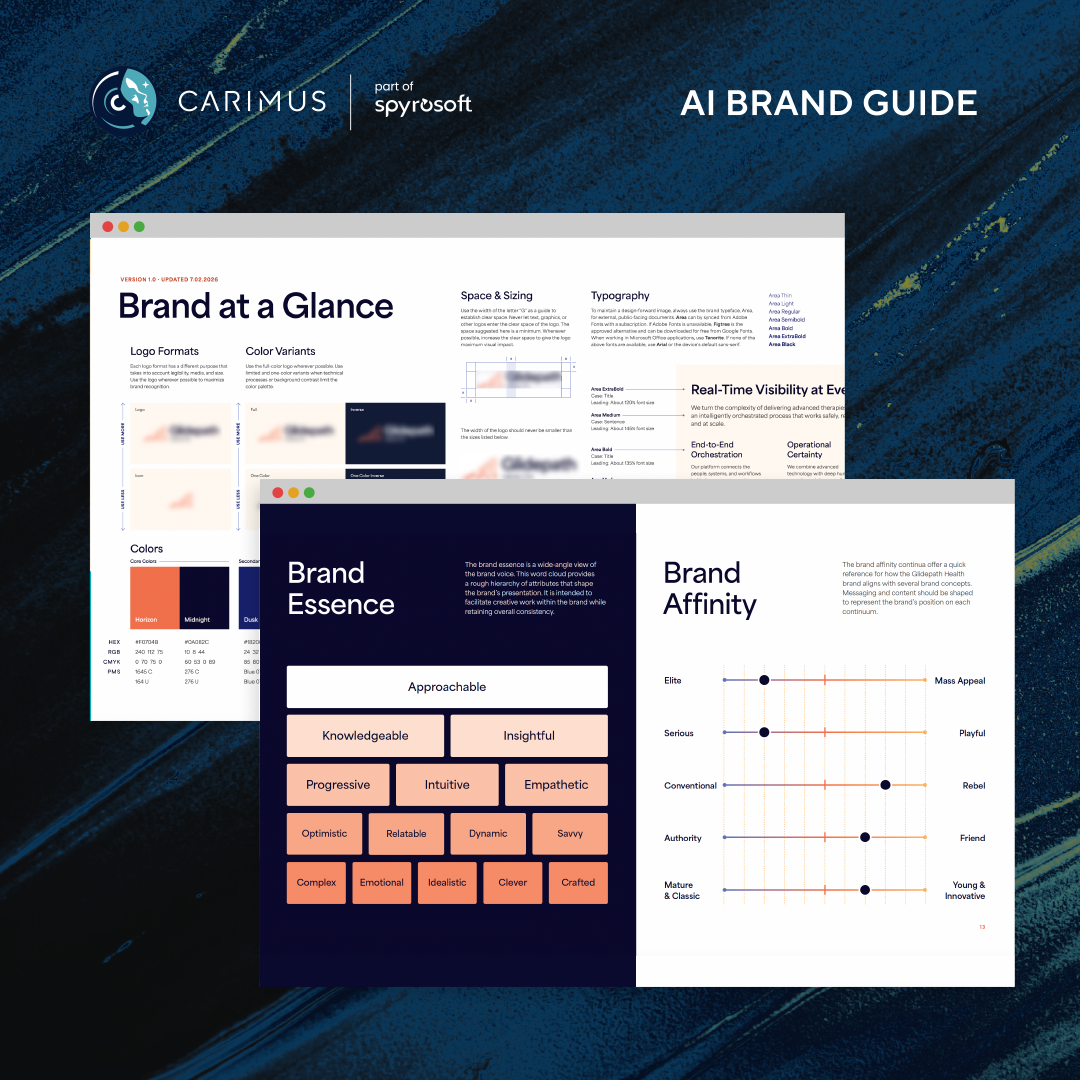
The quality of what AI produces for your organization is directly proportional to the quality of what you give it to work from. Brand voice. Tone guidelines. Content examples. The specific language your audience responds to and the specific framing your brand owns. These are not just assets for your human team members anymore. They are the inputs that determine whether AI-assisted output sounds like your organization or like a generic version of it.
Most teams skip this step. They adopt the tools, skip the foundation work, and then wonder why the output never quite sounds right. Every piece requires extensive rework. The voice drifts. The output is technically correct but never quite on brand. And because the problem is invisible, it rarely gets fixed.
The organizations getting real returns from AI have done the opposite. They treated brand documentation as infrastructure, built the foundation before scaling the output, and now get compounding returns from every tool they adopt.
The tools are ready. The question is whether the foundation is. If the answer is not yet, that is the right place to start.
Carimus builds AI tools for the work marketing teams actually do. Start with a free website audit through Orbit, or talk to your account team about Scout.
Learn more at carimus.com
Ready to see what Your Website Could Be Doing for Your Pipeline? Let’s Connect
“What I love about the culture at Carimus is that it thrives on a foundation of passion and excellence, where every individual is not just an employee but a valued contributor to our shared success story.
”
Blog & Posts